2. What actually makes matcha, matcha?
Not every green tea powder tells the same story — and buyers need to know the difference.

Two products can both be labelled “matcha” — but they may not be the same product.
One may be made from tencha, the raw material used for matcha, produced specifically to be milled into a fine powder. Another may simply be powdered green tea.
To a customer, both may appear as a green latte on the menu. But for coffee shops and roasters, the difference matters.
It affects flavour, colour, bitterness, texture, cost, and how confidently staff can explain the drink to customers.
As demand grows, the word “matcha” is being used more widely than ever. This is not necessarily the fault of buyers. Many coffee shops want to serve better matcha, but the information they need is often unclear or missing.
So before buyers compare origin, price, grade, or supplier, they need to ask a more basic question: what actually makes matcha, matcha?
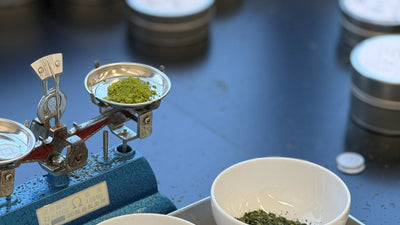
 Matcha begins with raw material — tencha, weighed and evaluated like a specialty product.
Matcha is not defined by powder alone
The most common misunderstanding is simple: matcha is not just green tea ground into powder.
Powder is only the final form. What matters is what happens before that.
Matcha is defined by the raw material, cultivation, processing, harvest timing, and intended use. The tea must be grown and processed in a way that makes sense for a product consumed as a whole powder, rather than brewed as loose leaf tea.
“In coffee terms, grinding a lower-quality coffee more finely does not make it specialty coffee. In the same way, grinding green tea into powder does not automatically make it matcha.”
This distinction is becoming more important as matcha demand grows. When everything green and powdered is called matcha, buyers lose the ability to understand quality. Producers who invest in the right cultivation and processing also become harder to recognise.
For coffee shops, this is not only a technical issue. It is a purchasing issue, a menu issue, and a communication issue.
Two different paths: aracha and tencha
To understand matcha, it helps to understand how Japanese tea branches into different production paths.
After harvest, fresh tea leaves are processed quickly to stop oxidation. From there, the production route determines what kind of tea the leaves can become.
For many Japanese leaf teas, the leaves are processed into aracha — crude, unfinished tea. Aracha is a trade-stage product that still needs finishing. It may later be sorted, refined, and finished into products such as sencha.
In simplified form: fresh tea leaves → aracha → finished leaf teas such as sencha
Matcha follows a different path. For matcha, the leaves are processed into tencha. Tencha is not rolled like sencha. It is produced specifically to become matcha. After steaming and drying, the leaves are refined and milled into a fine powder.
In simplified form: fresh tea leaves → tencha → matcha
 Tencha — produced specifically to become matcha, not brewed as leaf tea.
For coffee professionals, it may help to think about this in relation to coffee processing. At a washing station, coffee cherries are processed into parchment coffee. But parchment is not yet the final export-ready green coffee that roasters buy. It still needs to go through dry milling: hulling, grading, screening, density sorting, and colour sorting. Only after these steps can it be prepared as an exportable specialty coffee lot.
 Like coffee’s dry mill, tea passes through refining and sorting before it becomes matcha.
Japanese tea has a similar idea of intermediate and finished stages. Aracha is not the final finished product in the same way that parchment is not the final exportable coffee. Tencha is an intermediate product created for a different destination: matcha — the raw material designed to be refined and milled into powder.
“Matcha is not created simply at the moment tea is milled. It is created much earlier — in the decision to produce tencha rather than ordinary leaf tea.”
For buyers, this means one of the most important questions is: Is this made from tencha?
Harvest timing changes quality — and price
 Harvest timing shapes quality and price — spring and autumn serve different purposes.
Once buyers understand the difference between tencha and powdered green tea, the next question is harvest timing.
Not all tencha is the same.
In Japan, spring harvest is generally associated with higher quality. The first harvest of the year often produces leaves with more sweetness, umami, vivid colour, and a smoother profile. It also tends to command significantly higher prices.
In many cases, spring harvest matcha can cost much more than autumn harvest matcha. For buyers preparing matcha straight, or offering a premium matcha service, spring harvest can be worth the higher cost.
But this does not mean every coffee shop needs spring harvest matcha for every drink.
For milk-based drinks, the priorities are different. A matcha latte needs colour, structure, balance, and enough flavour to stand up to milk. It also needs to work within a realistic menu cost. In some cases, autumn harvest matcha can be a practical option for cafés — it may not have the same delicacy as spring harvest when prepared straight, but it can perform well in lattes if it has good colour, balanced bitterness, and enough body.
Choosing well does not always mean choosing the most expensive matcha. It means choosing the matcha that fits the drink.
Why this matters for coffee shops
For coffee shops and roasters, understanding what makes matcha, matcha, has practical consequences.
If a product is made from tencha, buyers can begin asking more meaningful questions about harvest, region, cultivar, processing, and suitability. If a product is simply powdered green tea, it may still have a place in certain applications, but it should not be evaluated or priced in the same way as properly produced matcha.
A matcha may look acceptable in dry powder form, but become dull in milk. It may taste pleasant when sweetened, but harsh when served straight. It may be affordable, but difficult for staff to explain. It may carry a premium label, but lack the background to justify the price.
For cafés, the better questions are:
- What is it made from?
- How was it processed?
- When was it harvested?
- What drink is it best suited for?
- Can we explain its value to customers?
What buyers should ask suppliers
As matcha becomes more expensive and harder to source, buyers need better questions. Before choosing a matcha, coffee shops and roasters should ask:
- Is this made from tencha?
- Where was the tea grown?
- When was it harvested?
- Was it spring harvest, autumn harvest, or another harvest?
- Was it produced for straight preparation, latte, or food service?
- How does it perform with milk?
- How does it perform when prepared with water?
- What explains the price difference between this and other options?
- Can the supplier explain the production background?
These questions do not require buyers to become tea experts. They simply help buyers understand what they are buying. And in today’s market, that matters more than ever.
Understanding matcha starts before the powder
The more popular matcha becomes, the more important it is to understand what the word actually means.
Not every green tea powder tells the same story. Some powders begin as tencha, produced specifically to become matcha. Others begin as leaf tea, later ground into powder. Some are best suited for premium straight service. Others may work better in milk-based drinks. Some justify a higher price through harvest timing, raw material, and processing. Others may be expensive simply because the market is tight.
For coffee shops, the goal is not always to buy the most expensive matcha. The goal is to buy matcha that makes sense — understanding the route from leaf to powder, knowing whether the product is tencha-based, and matching harvest and quality level to the intended drink.
In the next article, we will look at another important question: why does Japanese origin matter in matcha?