3. Why Japanese origin matters in matcha
“Japanese” is a valuable starting point — but buyers need to understand region, producer, harvest, and purpose.

For many buyers, the words “Japanese matcha” sound like a quality guarantee.
And in many ways, Japanese origin does matter. Japan has developed the production knowledge and infrastructure required for high-quality matcha: tea cultivation, tencha processing, finishing, sensory evaluation, and a shared understanding of how matcha should taste and perform.
But “Japanese” alone is not the whole story.
“Just as ‘Ethiopian coffee’ or ‘Kenyan coffee’ does not tell a roaster everything they need to know, ‘Japanese matcha’ should be understood as a starting point — not the final answer.”
Which region in Japan was it produced in? Who produced it? Which harvest is it from? Is it a single origin, a blend, or a product designed for a specific use?
As matcha becomes more expensive and more widely used in coffee shops, buyers need to look beyond the country name. They need to understand origin more deeply.
Japan matters because production knowledge matters
Japanese origin matters in matcha not only because of history or reputation, but because of accumulated production knowledge.
High-quality matcha depends on many decisions made long before the powder reaches the buyer: how the tea is cultivated, when it is harvested, how the leaves are processed into tencha, how the material is refined, and what kind of final use the matcha is intended for.
Japan has built systems around these decisions over generations. Farmers, processors, tea finishers, and buyers have developed shared expectations around colour, aroma, sweetness, umami, bitterness, texture, and balance.
This does not mean every Japanese matcha is automatically high quality. It also does not mean good tea cannot be produced elsewhere. But it does mean that Japan has a deep foundation for producing matcha at a high level, especially when the product is made from tencha and designed with a clear purpose.
For coffee professionals, this idea should feel familiar. A country’s reputation matters, but reputation alone does not define quality. Coffee from a famous origin can be excellent, average, or poorly handled. The same is true for matcha. The value of Japanese origin is real. But it must be understood through specific production details.
Climate, landscape, and slower growth shape tea quality
 Climate, landscape and slower growth shape what a tea can become.
Origin is not only about nationality. It is also about climate, landscape, and growing conditions.
Coffee professionals understand this well. In coffee, cooler temperatures, altitude, and slower maturation can contribute to complexity, sweetness, and structure. A coffee’s environment shapes its potential.
Tea can be understood through a similar lens. In Japan, many high-quality tea regions benefit from significant temperature differences between day and night, careful water management, and growing environments where tea does not develop too quickly. In some mountainous or semi-mountainous areas, cooler conditions and moderated sunlight can contribute to slower growth and more concentrated flavour.
Cooler conditions and slower growth do not automatically create quality, but they can give farmers the potential to develop sweetness, aroma, and structure when harvest and processing are handled well.
This does not mean that all mountain tea is better, or that all flatland tea is inferior. As with coffee, quality depends on the interaction between environment, farming, harvest timing, processing, and purpose. But it does mean that buyers should ask more specific questions about where the tea was grown, why that origin was selected, and how it relates to the intended use.
Japan is not one single origin
 Japan is not one origin — Kagoshima, Shizuoka and others each tell different stories.
For international buyers, “Japanese matcha” can sound like one category. But Japan is not one single origin.
In coffee, no roaster would assume that all Ethiopian coffees taste the same. Sidama, Yirgacheffe, Guji, Jimma, and Limu all tell different stories. The same is true in Kenya, where coffees from Nyeri, Kirinyaga, Embu, or Kiambu can show different characteristics.
Matcha should be approached with the same mindset. A matcha from Kagoshima, Shizuoka, Kyoto, Aichi, or Fukuoka may all be Japanese, but each region has different climates, production histories, and market strengths.
Even within one prefecture, there can be important differences between flatland areas and mountainous areas, between large cooperative production and smaller producer-led lots, and between teas designed for blending and teas intended to express a more specific origin.
For buyers, this matters because “Japanese” is too broad to explain quality on its own. A matcha from one region may be vibrant and structured, suitable for milk-based drinks. Another may be more delicate, sweet, and umami-driven, suited for straight preparation. Another may be designed for consistency and price stability across a café menu. None of these uses is wrong. But buyers need to know which kind of origin story they are buying.
Single origin, blending, and transparency
As matcha becomes more popular among coffee shops and roasters, the idea of single origin matcha is becoming increasingly important.
In specialty coffee, single origin is valued because it helps buyers understand where a coffee comes from, who produced it, and why it tastes the way it does. Single origin matcha can play a similar role — it allows buyers to understand region, producer, harvest, and intended use more clearly.
However, this does not mean blends are bad. In Japanese tea, blending has a long and important history. Skilled blending can create balance, consistency, and a flavour profile that is stable across seasons. For many café operations, this consistency can be valuable.
The issue is not single origin versus blend. The issue is transparency. If a matcha is a blend, buyers should understand what is being blended and why. If it is single origin, buyers should understand what makes that origin meaningful. In both cases, clear information helps buyers evaluate value.
“For coffee shops, the goal should not be to chase a label. The goal should be to choose matcha whose background can be understood.”
What buyers should ask beyond “Japanese”
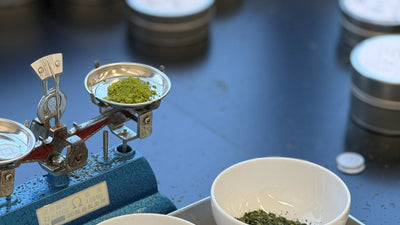
 Beyond the label: evaluating samples by region, producer and intended use.
If a product is labelled “Japanese matcha,” buyers should treat that as the beginning of the conversation. Before choosing a matcha, coffee shops and roasters should ask:
- Which region in Japan is it from?
- Who produced it?
- Is it from a single producer, single region, or a blend?
- Which harvest is it from?
- Was it produced from tencha?
- What kind of flavour profile does it have?
- Is it better suited for latte, straight preparation, or food service?
- What explains the price difference between this and other Japanese matchas?
- Can the supplier explain the production background clearly?
These questions do not make the buying process more complicated for the sake of complexity. They make buying decisions more reliable. When buyers understand origin, they can choose more appropriately, build better menus, and support producers whose work would otherwise remain invisible.
This is especially important as matcha becomes more expensive. In a rising market, vague origin language can hide a lot. Clear origin information helps buyers understand whether a price reflects quality, scarcity, labour, reputation, or simply market pressure.
Origin is the beginning of better matcha selection
Japanese origin matters in matcha. It matters because Japan has accumulated the agricultural knowledge, processing skill, production systems, and quality expectations that have shaped matcha over generations.
But “Japanese” is not enough.
For coffee shops and roasters, the next step is to understand matcha more like they already understand coffee: through origin, producer, harvest, processing, purpose, and relationship. A country name can open the door, but it cannot explain everything behind the product.
“Origin is not only geography. It is also human work.”
 Origin is also human work — the producers behind the cup.
The better question is not only: Is this Japanese matcha? It is: Where in Japan does it come from, who made it, when was it harvested, and what is it best used for?
This shift matters because matcha is no longer a small niche ingredient. As it becomes a more important part of café menus, buyers need better information and better language to describe value. Japanese origin is a meaningful starting point. But better matcha selection begins when buyers look beyond the label.
In the next article, we will look at the farmers and producers behind Japanese tea — and why their work has long been undervalued, and why their future may depend on how this new matcha market develops.